

Programme at Government Primary Schools and the Role of Volunteering
Our experience working with the government school system and the corporate volunteers
For the past three years, Paper Ball Educational Innovation has been creating spaces that allows children, youth and adults to understand and observe nature closely and to practice sustainability by understanding interconnections in the universe and how our actions impact our environment.
Most of our beneficiaries and participants were from the urban areas and comprised of adults and children who were already a bit inclined towards nature and environmental issues. So when we decided to take our programmes to the government schools, it required a lot of work at the back-end, including designing the programmes that we could offer to the schools, the grades and the experiential activities to go with it.
But why did we want to take our programmes to the students at the government run schools?
We realized that environmental education is important for all children but for those from lower socio-economic backgrounds, it becomes deeply urgent and transformative, not just informative. Children from marginalized communities are more exposed to polluted air, unsafe water, heat stress, flooding, and poor sanitation.


They often live closer to waste sites, industrial zones, or degraded ecosystems
- Climate shocks (heatwaves, floods) hit them first and hardest.
- Health impacts (respiratory illness, waterborne diseases) are more immediate
Environmental education here is not abstract but it is about survival, dignity, and daily decision-making. And so it seemed like a good decision to pilot our programmes with the government schools in the peripheral villages of Vadodara city.


We worked with the DPEO Vadodara for about 2 months to get approval for piloting our environmental (and Holistic Healthy Living) programmes in 10 schools in the two clusters. It took some time to convince the DPEO office about the need of these programmes, however, they were gracious to provide us approval to work in 10 schools on the periphery of Vadodara city. We received the approval in the second week of June 2026.
The approval came with several constraints but one that was most challenging was the limitation of day for sessions, that is, the sessions could only take place on Saturdays. With Saturdays, being a half-day at these schools, there is generally just an hour available prior to the mid-day meal that we could utilize for the sessions. Practically it meant that for 10 schools, we required a team of 20 facilitators for the sessions to take place at all schools simultaneously.
While this was happening, at the back-end we were also working (since April 2026) to ready a team for school programme facilitation. We were fortunate to receive support from the MNC Xylem Water Solutions India Private Limited (https://www.xylem.com/en-in/). The HR and CSR team led by Sh. Jigesh Patel suggested ways in which their employees (all engineers) could support us with school programme facilitation as a part of their social responsibility. We were able to discuss the kind of support needed, the sessions, the grades across multiple meetings. By the end of these meetings, we had 27 volunteers ready to take up sessions. There were excess volunteers on purpose to serve as back-up if any other volunteer was not available.
Once the approval was received from the DPEO office, we worked with the Xylem team by providing them facilitator guides for the 6 sessions of the Jal Mitra (our abridged and modified Nadi Mitra programme) that they had to lead at the schools. Then we had two training sessions with them as well as signing of the Child Protection Policy by each volunteer.
The Jal mitra programme had the following session objectives:
- Notice water in their everyday lives
- Develop curiosity about local water bodies
- Feel empathy for rivers, ponds, animals, and communities
- Think critically about water-related challenges
- Believe that their actions matter
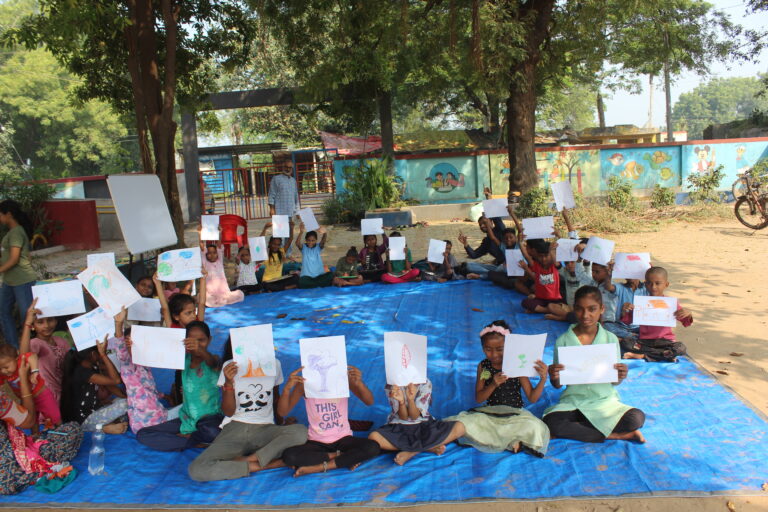
We started with the sessions in the 6 schools from 27-June-26 and our team received full support from the principals and teachers in these schools. The 6 schools where we started Jal Mitra sessions were Bil Prathamik Shala; Laxmipura Prathamik Shala; Samiyala Prathamik Shala; Raipura Prathamik Shala; Bhayli Kumar Shala and Bhayli Kanya Shala. We would also want to acknowledge the support provided by the principals: Ms Deepika Joshi (Bil Prathamik Shala), Ms Preeti (Bhayi Kumar Shala), Mr Pankaj (Laxmipura Prathamik Shala), Mr Rafiq Memon (Samiyala Prathamik Shala), Ms Varsha (Bhayli Kanya Shala) & Mr Navin Panchal (Rampura Prathamik Shala).


Over the course of June and entirety of July, we could complete 4 sessions on each Saturday, without any issues, however 25th July, Saturday and later 1st Aug, Saturday were declared as a holiday by Disctrict Collector owing to red alert for heavy rainfall. Post that 8th Aug, Saturday was Baal mela at several schools and that hampered our continuity. Then the Saturday after that was 15th Aug and the week after that was term examinations. Phew!!!
But with support from the school principals and facilitators, we were able to complete the programme at 5 schools before 15th Aug and at one remaining school on 27th Aug.


Were we able to achieve all our objectives from the programme?
The quick answer is probably not. However, even while designing the programme we were aware of some of the challenges and disruptions we could face and we had planned sessions accordingly. However, the facilitator teams were definitely able to work with around 240 of these students from grade 6th to grade 8th and made them aware of the role of water and water bodies through multiple experiential activities. There was high retention and understanding of the concepts like ecosystems, water cycle, ponds, ground water, pollution and so on. Due to school closures (rain, baal mela, exams, festival etc.) falling on Saturdays, we could not work on the mini project for Jal Mitra programme as was planned. However, the basic idea of the importance of water and water bodies was well imparted.
The children could see and relate to the fact that how without water there simply cannot be any life. That all parts of their lives are intertwined with water – water is needed not just for cleaning and bathing but everything that they use, requires water in some form for it to be manufactured. They also realized that although Earth is 71% water, however, freshwater is a miniscule 2.5% and even most of that is locked in glaciers. There were moments of wonder in the classroom and open discussion. On the waterbodies front, the children could relate to the fact that waterbodies in their villages are strewn with garbage and that a lot of liquid waste from many homes flows into it. They could understand the ecosystem around waterbodies and the fact that waterbodies are not just for us humans but so many spcies are dependent on these water bodies and hence it is our responsibility to keep them clean.
The sessions were made in the format where children could relatecontextually, observethe challenges, organizetheir learning and take steps to transformand share the same with others. The sessions were supplemented by group activities, discussion questions, reflections, videos, bingos, crossword puzzles, drawings, colouring and more.


Our Achievement beyond sessions at school?
The idea was to run the programme for the students for grade 6 to grade 8 in these selected schools. However, as an organization we achieved something more. We not only got support from a team of engineers who wanted to volunteer for social issues but who also got to learn a bit more about the challenges facing our water bodies on the ground. They felt that they themselves have been enlightened about the water related issues facing each one of us even though we do not realize the same.
The volunteer team at Xylem, led and coordinated by Prashant Miyani put in extra efforts to discuss activities and design a few new ones in line with the session objectives. They took time to discuss how to run these activities during sessions. This was a new experience for us too as we haven;t generally seen volunteers putting in this much effort to ensure that the session goes well. This has actually raised our confidence in utilizing volunteers to augment our efforts.
So not only did we reach out to about 240 students in these schools but also got about 27 ambassadors of change in the form of our facilitator volunteers.


The current status: As of 9-Sep-26, the school programme is continuing in 6 schools. Currently, we are working with grades 6th to 8th on our Holistic Healthy Living (HHL) programme provided by our partner Nisargopachar Kendra and being conducted by a separate team of facilitators trained specially for HHL programme. The HHL programme focuses on helping children become aware of different facets of health beyond just right food and nutrition. The programme focuses on Physical Health, Mental Health, Emotional Health, Social Health and Environmental Health.
Post this programme, we will move to the short 5-session progamme on Solid Waste Management, its understanding, source segregation, managing the solid waste, composting, and recyling. This will depend on the amount on time that the schools have available with them.


Final Thoughts:
Working with the government school system is rewarding as it helps meet our objective of raising awareness for a larger group of children. At the same time, these programmes are generally treated as low value (or importance) by the school systems as they are not driven or directed from the top. Organizations like ours put in a lot of resources, efforts and time to make these programmes a success, but the value of these programmes is not seen by the school system.
As an organization, the need to balance the limited resources that we have with the efficiency and effectiveness of the programmes is the prime driving factor. That is the reason we embarked on this pilot with the government schools. Based on this pilot and our experiences, we will take a call on how to move with our programmes in the government school system.