
The Making Of The Dust Bowl
Article first published on LinkedIn on 15-Dec-25 by Amit Arora
Part 2 of the long-read series from the historical archives about human intervention with nature and climate and its consequences
The Great Plains
In the early decades of the twentieth century, the Great Plains of the United States were celebrated as a triumph of human ingenuity. Stretching across states like Oklahoma, Kansas, Texas, and Nebraska, this vast expanse of grassland had long been regarded as marginal land—too dry, too windy, too unpredictable for intensive agriculture. Indigenous communities understood its rhythms well, allowing native grasses to anchor the soil while grazing animals moved with the seasons. But the arrival of modern farming technologies changed this relationship entirely. Steel ploughs, mechanized tractors, and new wheat varieties promised abundance, control, and permanence. In an era shaped by optimism and industrial confidence, the land was no longer seen as a living system but as a resource waiting to be improved.
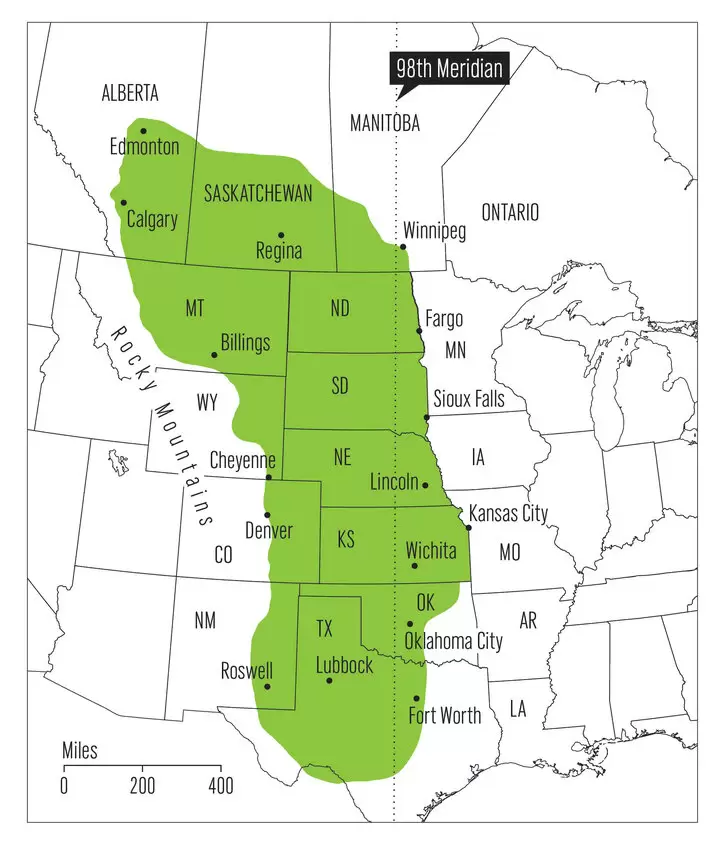
Mechanized Agriculture took off in The Great Plains without regard to its specific ecosystem
Encouraged by government policies, wartime demand for grain, and a widespread belief that technology could overcome natural limits, farmers began to plough the Plains at unprecedented scales. Millions of acres of deep-rooted prairie grasses were torn from the soil and replaced with monocultures of wheat. The prevailing assumption was simple and persuasive: more land under cultivation meant more food, more profit, and greater security. Few paused to consider the ecological role those native grasses had played. Their roots, stretching several feet underground, had held the soil together through cycles of drought and wind for thousands of years. When they were removed, the soil remained productive for a time—but increasingly vulnerable.
Droughts of the 1930s
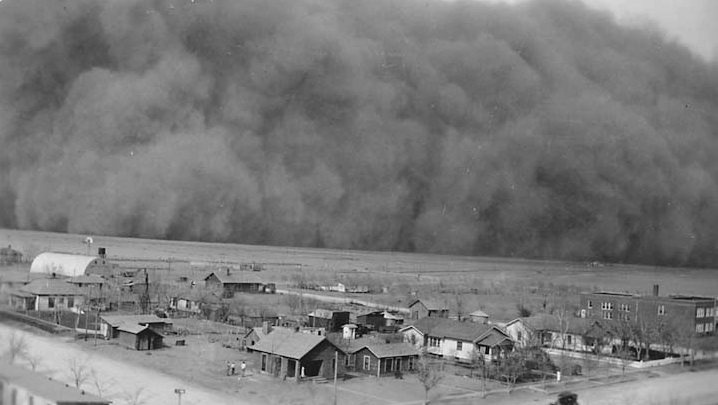
The vulnerability revealed itself with brutal clarity in the 1930s. A prolonged drought settled over the Plains, drying the exposed topsoil into fine dust. Without grass roots to anchor it, the soil became airborne. Winds carried it across farms, towns, and eventually entire states. Dust storms darkened skies at midday, turning sunlight into an eerie orange haze. Homes filled with grit despite sealed windows. Crops failed repeatedly, livestock suffocated, and families watched generations of work disintegrate into the air. One storm known as the Black Sunday dust storm, in 1935 lifted an estimated 300 million tons of topsoil, carrying it as far as the Atlantic Ocean. What had once been fertile farmland became a shifting desert.
A Consequence Of Human Experiments On Nature
The Dust Bowl was not merely a natural disaster. It was a direct outcome of environmental engineering shaped by misplaced confidence. Farmers had not intended to destroy the land; they were responding rationally to economic incentives and technological promise. Yet the belief that human tools could permanently override ecological limits proved dangerously flawed. By treating the Great Plains as a static system rather than a dynamic living one, the agricultural practices of the time ignored variability in climate, soil moisture, and wind patterns. The land responded not with gradual decline but with sudden collapse.
The social consequences were immense. Hundreds of thousands of families were forced to abandon their farms, joining waves of migrants who traveled west in search of work. Entire communities disintegrated as banks failed, schools closed, and local economies collapsed. The Dust Bowl reshaped American environmental policy, leading to the creation of soil conservation programs and a renewed emphasis on sustainable land management. It was only after devastation that the importance of crop rotation, windbreaks, and soil cover was widely recognized. The lesson was learned, but at extraordinary cost.
Relevance of the Dust Bowl Today
What makes the Dust Bowl particularly relevant today is not just its scale, but the mindset that enabled it. It emerged from a conviction that technological intervention—mechanization, monoculture, and expansion—could permanently stabilize nature and land in humanity’s favour. Additionally, it also highlighted the still-prevalent thinking that nature is subservient to humans. This same conviction echoes through modern climate debates. Today, instead of ploughs and tractors, the proposed tools are atmospheric particles, carbon capture machines, and planetary-scale climate interventions.
The language has changed, but the underlying assumption often remains the same: that complex systems can be adjusted with precision if the technology is sufficiently advanced.
The Dust Bowl reminds us that environmental systems often respond non-linearly. Damage can accumulate invisibly for years, only to surface suddenly when conditions shift. In the 1920s, the Plains appeared prosperous and stable. It took only a few years of drought to expose the fragility beneath that stability. Similarly, climate engineering proposals today may appear manageable in models and simulations, yet their real-world consequences may unfold in unexpected ways—particularly under extreme conditions.
There is also a deeper parallel. The Dust Bowl did not solve the problem it was meant to address. Intensive agriculture was intended to create food security, yet it ultimately undermined it. In the same way, climate engineering proposals that focus on masking symptoms—such as heat—without addressing underlying causes—such as greenhouse-gas emissions and unsustainable consumption—risk repeating the same mistake.
Technological interventions may offer temporary relief while increasing long-term vulnerability.
Human Arrogance of Supremacy
The Dust Bowl stands as a cautionary tale not againsttechnology itself, but against human arrogance. It demonstrates what happens when efficiency is prioritized over resilience, when short-term gains outweigh long-term system health, and when human confidence eclipses ecological understanding. It shows us that land, like climate, remembers what we do to it—and responds according to its own logic, not ours.
As discussions around climate intervention grow more urgent, the history of the Dust Bowl urges restraint. It asks us to consider whether we are once again mistaking control for wisdom, and innovation for understanding. The storms of the 1930s did not arise because people failed to act; they arose because people acted too confidently, too narrowly, and without sufficient respect for complexity.
Nearly a century later, the dust has settled, but the lesson remains suspended in the air: when we attempt to engineer nature as though it were inert, we may find that it responds not with compliance, but with consequences.
At Paper Ball Educational Innovation we are trying to take the hard way by building “communities that care” (ctc) for the planet. We believe that it can only be through the small action of each one of us that we can really see a force maximisation and build momentum to overcome the wicked and interconneted problems of environmental degradation, biodiversity loss and planetary warming that we are facing today. Technology can only act as an enabler once we understand humanity’s place in the scheme of things (which is definitely not at the top of the pyramid of our own making)